
CANTERBURY'S 2024 PREMIERSHIP STORY
THE HARD WAY
Written by Phil Johnson
Photos by Steve Smith/VAFA HQ
Canterbury was staring down the barrel of another heartbreaking loss when it took on St John's in the 2024 VAFA Division 3 Grand Final.
Seventeen minutes into the final term, despite being in control for most of the game, The Cobras had kicked six goals and 22 behinds. It was frustration and fortune in equal measure because despite the inaccuracy in front of goals, they only trailed by one point. They just couldn't convert, and time was starting to run out.
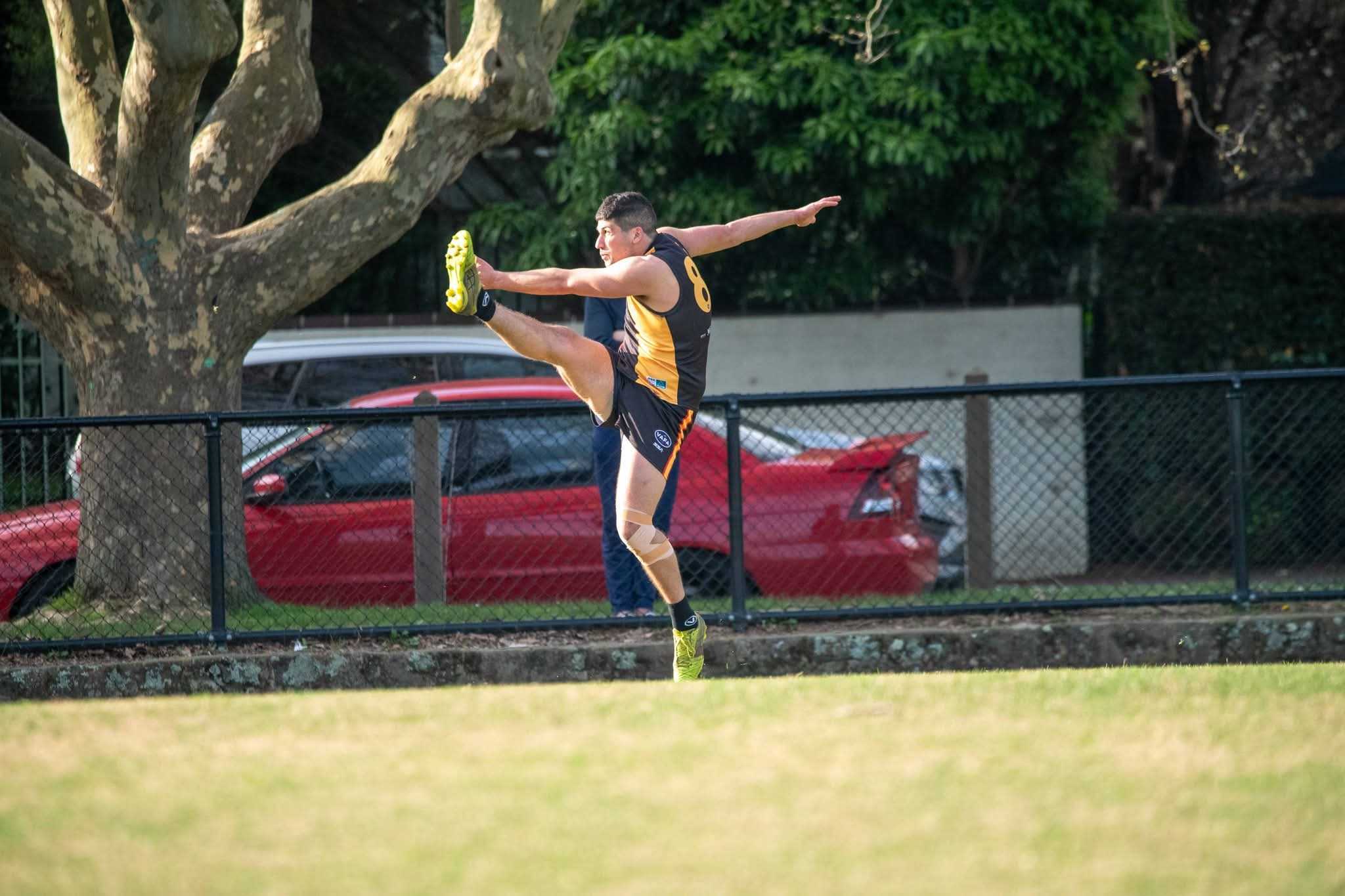
Enter Rohan Walmsley. The Canterbury veteran, who had his own tale of grand final heartbreaks, had won a free kick for holding the ball and was lining up about 30 metres out on a slight angle.
It's a situation most kids dream of. As an adult, the scenario can weigh a little differently. Walmsley kept it simple.
"Well, you've spent your whole life wanting to win one," he said to himself as he was lining up for goal. "You better not miss the kick."
It wasn't the first time the club faced a moment of consequence. Three years earlier it was searching for a coach. A year after that, it was in a financial hole tens of thousands of dollars deep. It was the sort of existential crisis that has seen other clubs disappear.
But whether it's on the field or off, the path to success is the same. When the result is up for grabs, put your best people in their best positions and let them do their thing.
It's a simple theory but harder to put into practice because finding the right people can be the tricky part.
From the Ashes
About six weeks before the start of the 2021 season, Canterbury found itself in turmoil. It had lost its coach suddenly, and training numbers were low.
"We were imploding," says club stalwart Sean Woodward. "They were pretty hard times."
So a group of senior players and officials met at the Matthew Flinders Hotel to map out a plan. Steve Pimm took over as head coach with Nicholas Szabo as his captain. The aim, simply, was to get a bit of stability, but without them knowing it, the seeds of the 2024 flag were being planted.
"Pimmy did an amazing job," says Woodward. "He brought everyone together during a really difficult time and Buckets (Szabo) was amazing as captain. He led the way on and off the field."
The club avoided relegation and in doing so, built a spirit which was the foundation of what was to come.
It was during 2021 that Canterbury made a second approach to Nathan Walsh to join the club. An attempt to get him on board as a playing-assistant the year before didn't come to fruition. But the deal was settled after a group met him at a local park for a kick of the footy. This time he would join as head coach for 2022.
Work was also underway to get Josh Ward to be a playing-assistant. Ward, along with 2024 premiership teammates Brad Kelleher and Jayden Cutts, had been playing country football but had been training with The Cobras, which made the sell easier.
Building the Foundation
Walsh's impact was immediate. He drove new standards which saw the club make the finals in both his seasons in charge, losing a heartbreaking semi-final to Parkside in 2022, and making the Preliminary Final in 2023, when the Cobras' run was stopped by the powerful Elsternwick lineup.
"He structured a playing group in a way Canterbury hadn't been structured before," one insider says.
"There was this aura of 'we're just a local footy side and we're just going to play football', and then Walshy came in with a real grunt about him and demanded attention and time. He really got them fit. He galvanized them. The reward was in the (premiership) third year."
So while things were heading in the right direction on the field, there was still some work to be done off the ground. Club administration, especially executive roles, can be thankless tasks. But as Woodward says, there is something intangible about the club that makes Cobra venom run through people's veins because most who get involved, even on the periphery, want to stick around and see it succeed.
"Aaron Daniel is a clear example of that," he says. "He had no real connection but after one year of being an assistant coach, he's the president."
For his part, Daniel says BJ Lashbrook was looking to move on as president when Woodward made the approach.
"Woody sold me this amazing role, but I've been around sporting clubs long enough to know they're not amazing roles," he laughs.
"I probably thought I hadn't been at the club long enough to take over, even though I had really good friends around the club and gained the respect of a lot of people. It was more spontaneous, with Woody saying 'you're the man'."
Despite his initial reservations Daniel threw himself into the position and found the club in a deep financial hole.
Canterbury owed VAFA affiliation fees for 2022, and had a bill for the pending 2023 season, which totaled almost $30,000. Meanwhile, the club was owed about $17,000 for outstanding player subs and jumper costs.
"We were looking at being $46,000 behind before we even started the year," he says.
So over the next three months, a group including Daniel, Woodward, and treasurer Keith Bold got to work chasing up the money owed to the club, while also organising sponsorships.
"The club was strong enough on field – we just lost a final to Parkside in 2022 - so my whole focus was getting the club in order off field," Daniel says.
"The club was really battling (financially). It wasn't insurmountable. It was certainly fixable, but it required the playing group to do their bit. And to the credit of the footy club - men and women - every single person did. It certainly took the pressure off the club."
A New Coach, A Big Decision
But after two seasons in charge, which finished in two finals campaigns, Walsh stood down from coaching. It meant the club was looking for a successor heading into 2024.
It was shades of 2021, with a group of senior figures meeting to discuss what type of coach was needed to lift the club from being finals campaigners to premiership contenders. Mitch Szabo was the one who suggested playing-assistant coach Josh Ward.
The job appealed to Ward because he already thought the club was a strong premiership chance, and he didn't want anyone to come in and bungle it.
"When I took it over that was one of the reasons," Ward says. "I genuinely believed we could well and truly win it all, all going right."
It was a view shared by many inside and outside the club, especially after Canterbury rejected a VAFA offer of promotion to Division 2, despite only finishing third. Fourth-placed Wattle Park went up instead, meaning Canterbury would be the only 2023 finalist to remain in Division 3 in 2024.
Daniel says that view – whether held by those inside or outside the club – was misplaced because newly promoted North Brunswick had won seniors and reserves premierships with a much-younger playing list than Canterbury's, while St John's, which was also promoted into Division 3, had recruited strongly. He says even the VAFA had expectations.
"I remember having a meeting with the VAFA and we basically got called big fish in little pond at the time," he says. "And I said that's absolutely not true."
Daniel says he reminded the VAFA that even though Canterbury had been in the division for the best part of a decade, the seniors had never made a Grand Final while the reserves hadn't played any finals.
"I said it doesn't justify a club going up just because we've played a couple of finals, including one we got belted in. The two teams that do get promoted - the two grand finalists - can struggle. If you're third, you're really going to struggle," he says.
"Early doors they just expected us to go 18-0. It was just staggering to think that they thought we were going to romp it in."
A Slow Start
Daniel was vindicated in round one, when a barnstorming finish by Power House saw Canterbury lose despite a comfortable lead at the final break.
"That was a reality check," says key defender and vice-captain Michael Topp. "Footy's not that easy. You don't win anything based on what you've done previously or what you think you deserve. You have to put in and make the effort and be the better team to win the game."
In fact Canterbury had registered just one win from its first three matches, and that was an unimpressive win against struggling Chadstone. The team hadn't found its mojo. Topp says having an older playing list was a factor.
"Our average age would've been closer to 30," he says. "A lot of the boys came back into the pre-season quite late. We didn't have the 18-to-21-year-olds running around for three or four months before round one, and who were all up to speed and flying.
"We had a lot of guys who came quite late – round one, round two. Some started round four or five, which meant we were playing behind a lot of other teams."
Josh Ward noticed standards weren't where they needed to be, even during comprehensive wins against lower sides.
"Tuesday night trainings were starting to teeter off in terms of attendance, so I said after a game that we were introducing a rule that if you're only going to train one night a week, it had to be Tuesdays. I think we had 12 blokes training that next Tuesday. Not an ideal response," he chuckled.
"There were certainly times throughout the year where I thought we were off the boil a bit. Guys going on holidays and not telling me till they were gone, and guys were finding reasons not to play. Things like that. The buy-in, the commitment, the discipline wasn't there, and I thought that's not the formula for a team that'll win it all."
That was evident by the number of players called upon during the season. More than 50 turned out for the seniors during the year, which is testament to the depth the club had. The reserves, led brilliantly by coach Tony Pisani, made the finals for the first time in nine years in 2024. Even thirds players were being called up for senior duty.
Ward: "To win it all, everything's got to go right. Whatever the level, it doesn't matter what it is, for you to win it all, everything's got to go right. It's got to work, and things weren't going right at the time, that's for sure."
Captain James Boarotto says there was a tremendous amount of character shown by those who knew they would be dropped as soon as regular senior players became available.
"Premierships are not just won by the 22 blokes on the day," he says. "If it wasn't for those guys grinding it out in the middle of winter, when some of these better players, me included, decided to go to Europe and enjoy our summer, they were the ones slogging away and getting the wins for us at a time when they were desperately needed."
Rohan Walmsley says there was no real system in the early wins.
"It was hard to get continuity and consistency and just the method going," he says. "I think we just won on talent, really. Eight blokes would just get us over the line. There wasn't a lot of outstanding stuff in that first half of the year. We just won when we needed to."
Well, not always. Just like in round one against Power House, Canterbury was in winning position against North Brunswick, only to have its opponent run over the top.
Walmsley agreed talent meant nothing unless there was a courage, a discipline, and a work ethic to put it into practice. "Everyone knew if – and it was a big if - if the stars aligned and with our personnel, we had the ability. But that doesn't guarantee you anything."
It was a frustrating start but despite the failure to get out of second gear for most of the first half of the season, there were signs of what was to come.
Signs of Life
Canterbury was the underdog when it traveled to St John's in round seven, but played the best it had all season to lead in the second half. However the home side fought back to seize the momentum – and a 10-point lead – 12 minutes into the final term.
Boarotto says Canterbury would have lost that game in previous seasons. Instead, the Cobras refused to give in and hit the front late in the game, and – despite a late onslaught by St John's – held on to win by six points.
"Yeah, I love that game," he says. "That was a real arm wrestle. Momentum swings left, right and centre. That win, for me, was probably one of the top three to the time that I've been involved in at the club. It definitely gave personal belief that we could beat the best sides, because at that time that they were beating every team, every week. You'd look at the scores after our games, and it was always St John's or North Brunswick by 150 points, compared to us beating the same side by 50 to 80 points. So to match it with them gave us real confidence."
Ward says he also saw a toughness that day, both physically and mentally, that he'd rarely seen at Canterbury.
"They kicked a goal to hit the front and once upon a time our heads may have dropped, but this year, we just found a way, and we continued to work," he says.
"And after we hit the lead, we forced a stoppage on their forward line. We won the clearance and moments later had players running into an open goal because they (St John's) didn't run back defensively. They're the things that - in years gone by - we weren't doing, and those sorts of games would fall out of our grip."
Walmsley, who's been at the club longer than any of his teammates, also describes it as a special win. "That was a big one. That was the one for me where I thought this team is showing something that I hadn't seen."
But there were some concerns it may have been a false dawn because that win aside, the team seemed to be going through the motions for the first half of the year. It wasn't until the round 12 away game against Richmond that things started to turn.
It was a bitterly cold and wet day at Kevin Bartlett Oval. The home side had tremendous support as it was celebrating its past players' day. Meanwhile, Canterbury had 15 players unavailable.
Walmsley says while Canterbury was never out of the top five, a win was needed to stay in touch with a top-three finish, to get the double chance in the finals.
"I was running the boundary that day, and I remember saying to Woody (Woodward) 'Jeez, this is the one. We need to bank it for the four points.' But with the amount of blokes we had out and with the wet conditions and all the support they had, I thought they could roll us.
"And they were all over us, really, for three quarters. We just got them back to around level-pegging on three quarter time, but they'd been the better side for three quarters. And then it was exactly that - a bit of belief and 'G and D'," Walmsley says.
"We were holding on and we weren't fizzling out," Ward says. "I think in years gone by we weren't holding on, winning those games. We were either winning comfortably or losing at arm's length. In previous years we weren't really in any games where we fought tooth and nail to get over the line. But we had those games this year, where we genuinely had to fight tooth-and-nail to find the win."
Mitch Szabo kicked two long goals in the final term as the Cobras got the win 6.11 (47) to 6.10 (46).
Boarotto says he sensed a change at training as well. He highlighted Nathan Beacom and Sam Hinton as leading the way on the track throughout the year, but said there weren't enough following their example.
"We were very fortunate to have some talented players come together on a Saturday. I wouldn't say that we came together on a Tuesday or Thursday too often and when it comes to those close games, if you haven't trained for it, you lose those games, but you still pat yourselves on the back for the great effort," he says.
"This year, it was similar in that we didn't train a lot together but as we started winning those close games there was a belief in the group and it encouraged a few blokes to get to training. Everyone just really enjoyed themselves and started getting around each other a bit more and really appreciated each other out on the ground."
Mitch Szabo says he noticed a change with the introduction of Matt Fotia into the team. Fotia had returned to football only weeks before after spending years away from the game to focus on cricket. Szabo says Fotia's enthusiasm lifted the mood, and standards followed. It gave the team another much-needed dimension.
"The vibe was up, and we played some really good footy," Szabo says.
Consequently, the results followed. Canterbury lost just one game in the second half of the year, and that was to St John's at home. It was a reversal of the first time they met. The Cobras were in a winning position at home only to lose by six points.
It meant Canterbury finished fourth and as a consequence, missed the coveted double chance. If Canterbury was to win the flag, it had to do it the hard way – four sudden-death finals in four weeks, with three of its four opponents beating the Cobras at least once during the year.
Captain Boarotto says as strange as it sounds, it worked in Canterbury's favour because it meant there was no room for complacency.
"We had a chance to lock up a top two spot if we beat St John's at home, and for three-and-a-half quarters, we were up by five or six goals and blew that lead," he says. "But I think that was a bit of a blessing in disguise.
"I think finishing fourth, having to do it the hard way, having to force blokes to come to training, it forced us to live and die each week, and obviously winning every game from fourth was an incredible feat, but I think it actually benefited a team like us."
Finals: One More Week
Canterbury faced off against fifth-placed Richmond Central in the Elimination Final but fixturing issues with the VAFA meant the venue wasn't known until later in the week, when it was decided the match would be at the Canterbury Sports Ground.
But the game didn't go to plan for the home side. Richmond Central had a two-goal lead at half time and only trailed by three points at the final break. Worryingly, it was kicking with a strong breeze in the final term.
Topp was one of a group of players who feared the worst. "I was walking to my position at half back, thinking, that's it. We're done. Silly Saturday next week. They'll kick five in the last quarter and that will be season over. What a waste.
"But the big change for us, from a playing perspective, was that we decided that in the midfield, we were just going to try to have as many stoppages as we could, slow the game down as much as we could. Eventually they'll get tired, and we'll come over the top by bulk stoppages and tackling hard and not letting the ball out. And that worked," he says.
"In the first minute, we had five stoppages in a row, and the ball didn't leave the center square. We kicked the first two of that quarter, and I was like, 'You know what? Maybe, just maybe, there is some hope'."
Canterbury kicked six goals to two into the strong breeze to win 14.10 (94) to 9.14 (68).
Ward says on reflection, that game was the greatest danger his team faced during the finals.
"We were under the most pressure against Richmond. They certainly came to play, and we were probably expecting to just roll over them. Without a doubt, they certainly came to play."
Both Ward and Topp say the lessons from the final against Richmond Central were applied through the rest of the campaign.
Topp: "The message of repeat stoppages, tackling hard and not letting the ball out was a big turning-point for the rest of the finals. As much as anything else, I reckon our midfield group put that pressure on the other teams' midfields over the next three games and that was what changed. That changed momentum from the way we played. We were harder at the ball. We were more stringent in the way we wanted other teams to win possession."
Ward: "After that Richmond game, during the next pre-game against Power House, I said there were guys, including myself, who were potentially playing in their last game. So what you have to remember, when it gets hard, when you've got to take that extra step, when you've got to put your head over it, or when you've got to do the hard things, you've just got to remember that we're playing for one more week. We're playing to extend our time. We're playing to continue playing. And that became our motto. One more week."
Szabo says the messaging had a profound effect on the players. "I was very nervous (at three-quarter time against Richmond), and I looked at Buckets (cousin Nicholas Szabo) and said 'this can't be the last game we ever play together. Can't be. We've got to do something here'. The same went with Wombat (Walmsley). This is not the last game. It's not the last game we play."
So, he says, Ward's theme of one more week really hit home.
"As a group, when we're having fun is when we're at our best," he says. "We let go of the expectations, because everyone had expectations on us that we should at least challenge for it, if not win it. We got to the point where we thought we'd just have fun and play for each other and enjoy our time."
Canterbury took on Power House in the semi final at Whitefriars College and overcame an inaccurate first half to pull away in a windy and rainy second half, winning 14.12 (96) to 12.5 (77).
North Brunswick and St John's played out a spiteful match in the other semi final, resulting in a number of key suspensions for both teams. St John's won the match so went straight through to the Grand Final, while North Brunswick would take on Canterbury in the Preliminary Final at Hadfield's Martin Reserve.
North Brunswick had beaten Canterbury in both home-and-away games, and conditions were the worst the players had encountered in years. It was bitterly cold and without exaggeration, the heavy rain occasionally came in sideways.
Boarotto says he was a little nervous heading into the game.
"They were the best drilled and best structured team we played (during the home and away season). They had a really strict game plan when it came to us in those two games in the year, we didn't have an answer," he says.
"We probably didn't have the game plan or the means to know how to beat a team that was well structured. We were very much just usually the better team on the day. So coming into that finals game, I was pretty nervous, knowing how well they defended and restricted us."
But Boarotto says one thing Canterbury had in its favour was the VAFA's decision to schedule the game at 9.20am.
"We were really embracing that, showing up wherever, whenever, and getting the job done. We embraced the fact that we're at a footy club at 8am. It's like we were in Auskick, aged six, seven, eight years old," he says.
"No disrespect to North Brunswick, but I think they may have thought, 'We're the best team in the comp. Why are we having to rock up at 9.20 in the morning to play a final?'
"So I always had in the back of my mind that I reckon they might come out just that 10% switched off. And obviously they had a few key players missing through suspension. But those two reasons had me thinking they'd come out strongly, but it may be only 80 per cent, so if we can come out at 100 per cent, there's no reason we can't be in control that entire game."
So it proved. With the exception of a period late in the third quarter – where North Brunswick kicked two goals to get the margin back to seven points – Canterbury controlled the game.
"There wasn't anything pretty. It was literally hailing at times and the wind was blowing a gale, but I think it was just a group determination and willingness to just get the ball moving forward, play wet weather footy," Boarotto says. "Then all of a sudden we find ourselves ahead by about a couple of goals in the last quarter and the sun comes out."
Canterbury controlled the rest of the game, kicking 4.4 to 0.5 in the final term to win through to the Grand Final 8.8 (56) to 4.6 (30).
The downside was a serious wrist injury to the tough and courageous Lachy Shearer, sustained late in the game. Shearer had played an integral role throughout the year and would have been a certain starter for the premiership decider.
The captain had high praise for his inspirational teammate.
"Just seeing the way he puts his head over the ball in every single contest, the fact he was playing with what I think was a broken wrist, a dislodged thumb, and I think another couple of injuries, just goes to show that he's one of those players that you love playing with, and you want him out there at all times. And I was just spewing for him that he couldn't play, but he was as much involved in the flag as anyone else on the day."
The Grand Final
There was a quiet confidence about the group by the time Thursday night's final training session was completed. Collingwood's 1990 Premiership captain and Norm Smith Medal winner Tony Shaw spoke in the rooms afterwards, and told the players to have trust in the process and the work they'd done to make the Grand Final.
Vice President Mitch Deane also spoke to the players to remind them they weren't just playing for themselves, but for all their families and friends, club supporters, volunteers, and other teammates who'd also be watching on. He left them with a simple message.
"Don't do it for those who say you can't. Do it for those who say you can."
The game was played at Martin Reserve, the same ground as the Preliminary Final, but at the more friendly time of 2.30pm. Just like the week before, the players went with the flow.
"I thought there was a definite, massive sense in our rooms pre-game, that we were pretty relaxed. Really relaxed, in fact," says Walmsley, who left for a Queensland family holiday after the Preliminary Final and returned for the premiership decider.
Walmsley says captain Boarotto was the one who set the tone in the rooms before the game.
"I think he got better and more comfortable as a captain over the year. He played his best game as a captain on Grand Final day. He was just cool, calm, relaxed. Didn't overplay it, and it just permeated through."
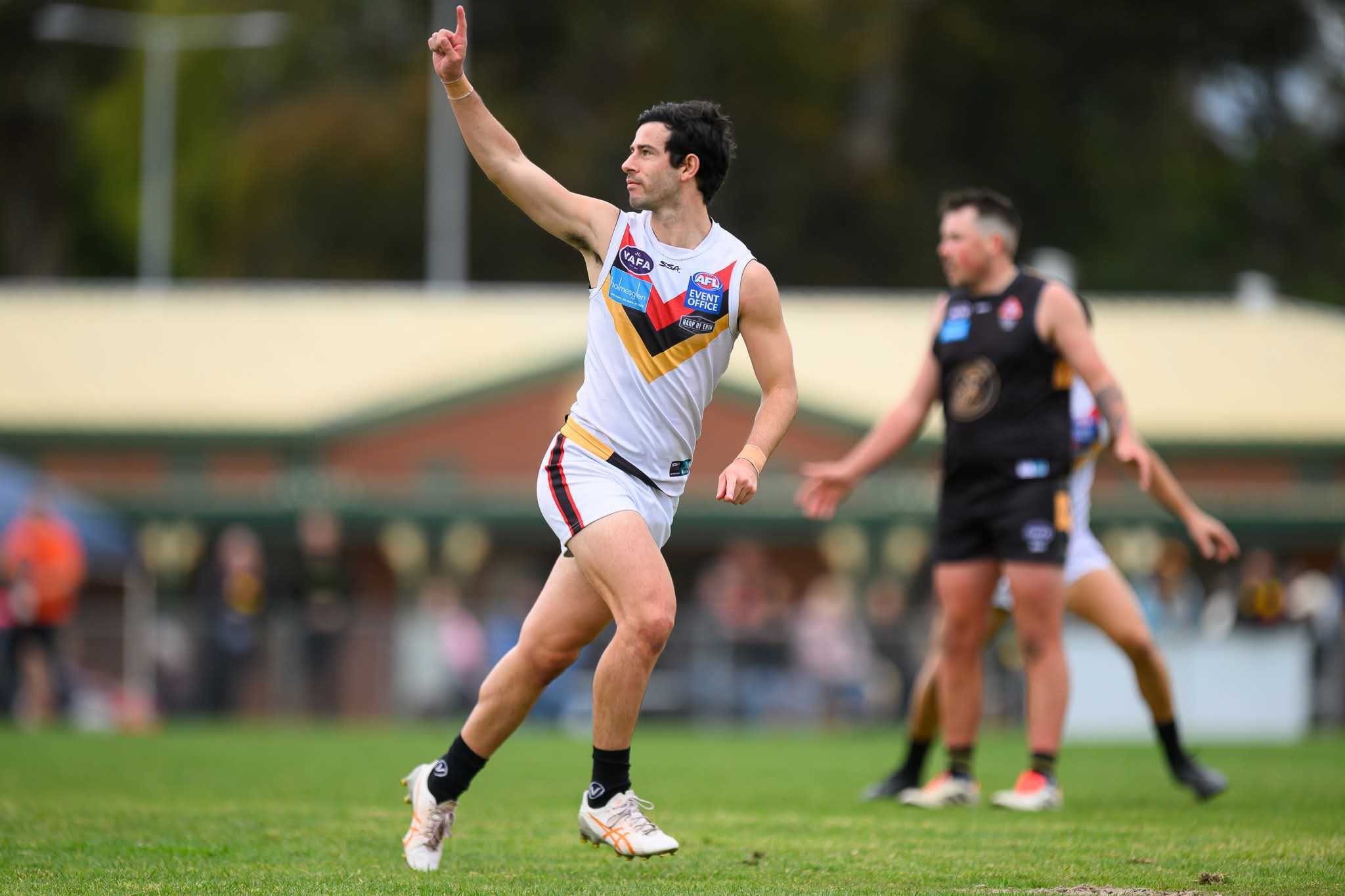
There was some rain that morning but a strong wind, favouring the goal at the southern end, remained throughout. It was the end to which St John's kicked in the first term.
St John's took the handful of opportunities it created but failed to capitalise on the advantage. St John's seemed to score every time the ball went into its forward 50, it's just that it didn't get there that often. Canterbury, meanwhile, played well into the wind and had the better of the quarter. As a result, scores were level at the first break – Canterbury 4.6 (30) to St John's 5.0 (30).
Canterbury had the better of the second term as well, but squandered the wind advantage with poor kicking. Both teams kicked just one goal for the term but The Cobras added a frustrating seven behinds. At half time it was Canterbury 5.13 (43) to St John's 6.0 (36).
Ward says the message was pretty simple at the main break. "We spoke about dictating, controlling tempo, controlling defensively, and doing what we need to do, just to square the ledger that quarter and give us a bit of a launchpad. We'd done that perfectly until one minute to go."
St John's had the wind again in the third term so it was vital Canterbury played to instruction, to keep St John's in check, which it did. It was only a late goal which gave St John's the lead 9.4 (58) to Canterbury's 6.16 (52).
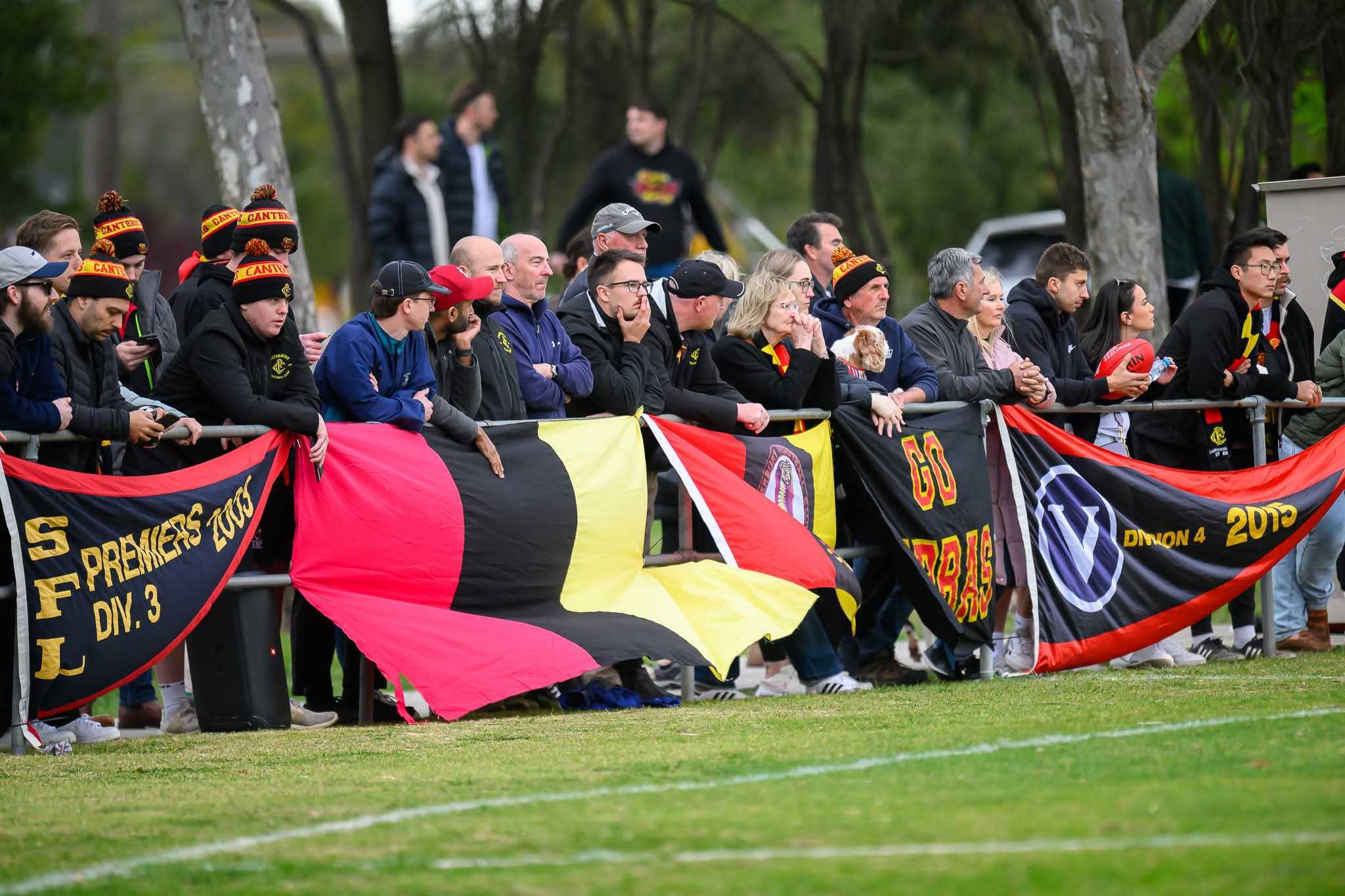
The players came in for their final address of the year, surrounded by the hundreds of Canterbury faithful who came out to support them. The noise from the St John's huddle could be heard 50 metres away.
Coach Ward, meanwhile, was much more measured in addressing his chargers. He didn't raise his voice but used his tone to convey the sense of urgency. With the exception of his last line, it was all business, with a simple plan and a simple theme. This is his three-quarter time address:
"We did exactly what we said we needed to do that quarter. We turned into a fight. We turned into repeated stoppages and contested it, and we kept going forward. We kept trying to score. That's a big tick. Okay? We're positive about that quarter. Now, we have the scoring end. We have the wind. It's not going to do it for us. Okay? We know what's happened in the second quarter. They're going to put all their numbers back. They're going to flood back. So, we need to move the ball quickly. We need to get it over the top. We need to get in deep, get in deep to Kellers (full forward Brad Kelleher), and he'll either take the mark or our boys will impact at ground level. If we are not able to do that, if it is a slow play, we need to lower our eyes. We can't get caught into bombing the ball to the top of the square to pack marks, boys. All right? That's a million to one. We're not going to win the game doing that. We're going to win the game playing quickly, getting over the top, getting it deep, or finding the right option, boys. Alright? We need to keep smashing it in the midfield, boys. We need to keep hitting the contest hard, and just because we're attacking, boys, we're attacking to win the game, it does not mean we do not transition run to support our backs back. The backs have been great. We need to support them now. Alright?"
He finished his address with the line: "Let's play the game, not the moment."
The supporters roared but the players were calm, almost without emotion. It should have been a sign. Professional coaches around the world say teams that settle first – the ones that can think clearly and act decisively when the heat is on – are invariably the ones that go on to win.
Not that it looked like that to those watching on. Canterbury kept peppering away only to squander chance after chance. The Cobras were doing exactly what Ward instructed but had scored just six behinds to St John's solitary point – its only score for the quarter as it turned out. The tension among the fans was palpable.
Ward says he remained confident in the last term. "I think there was one point we kicked four behinds in the first five or six minutes – all one-way traffic – and I was running back out, their ruckman says to me 'bloody hell, we're under pressure here'. And I said, 'I think we're going to get you with behinds at this stage', because I just didn't see them scoring. I just did not see a way they were going to score against us."
"That's what all of us who were talking in the backline thought," Szabo says. "We're just going to keep kicking points and we'll win it by two or three points."
Vice-captain and fellow defender Michael Topp says he was confident after the strong first quarter. "Yeah, we were in a great spot and I thought that was probably enough for me. I didn't want to hit 22 points and drag it all the way out to the end. I thought we might have put them away sooner, but I thought the way we played in that first quarter showed me enough to know they were not going to be able to match us."
"The funny thing is we kicked 6.22 but I can't remember anyone missing any howlers, really. It was more because it was a scrappy day," Rohan Walmsley says.
And that brings us back to where we started. Walmsley received a free kick after a tackle on an opponent was deemed holding the ball. He says he may have been fortunate to have received the free but he says it made up for one he was denied a little earlier.
"In the back of my mind I was thinking we have absolutely dominated all day, we're the better football team. We can and we should win. If this is one of those days where the better team kicks 6.30 and loses – and it was starting to look like it – but I still didn't think we were going to lose. We just had to kick one and the floodgates would finally open."
Tom Lowden swooped on the loose ball after the free was paid to Walmsley, but he kicked another point. Thankfully the umpire called it back because he hadn't paid advantage.
"The ball took what seemed like an hour-and-a-half to get back to me, so I had an inordinate amount of time to think about it, which was less than ideal," Walmsley says. "But I was confident in that I knew – for a left-footer – it was the perfect left-to-right. The way the wind was playing all day, I just had to kick it left-post and it was never going to miss."
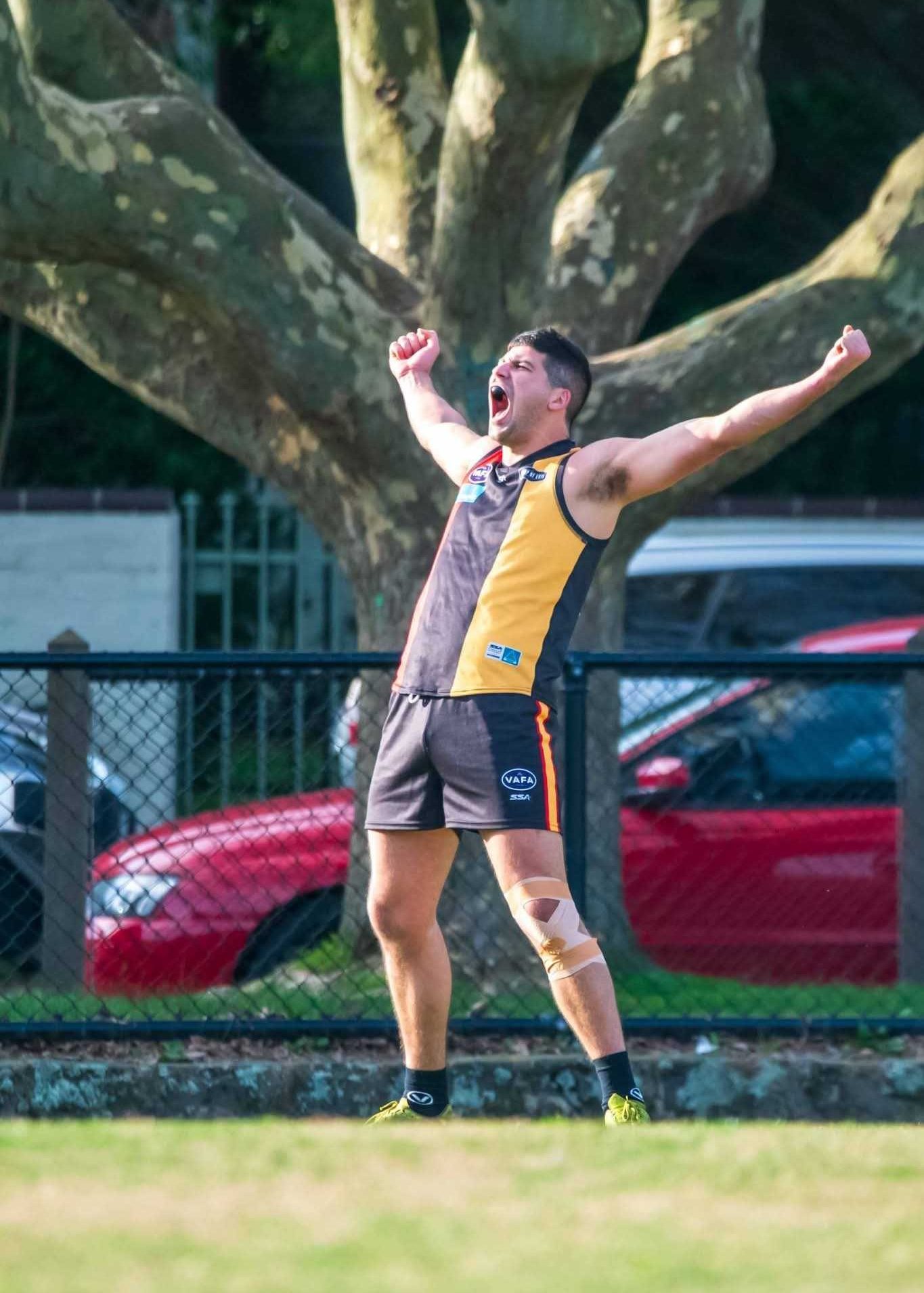
The crowd behind him knew it, too. As soon as it left his boot the Canterbury faithful went up. Walmsley joined in moments after.
"I hit it flush," he says. "It was never missing."
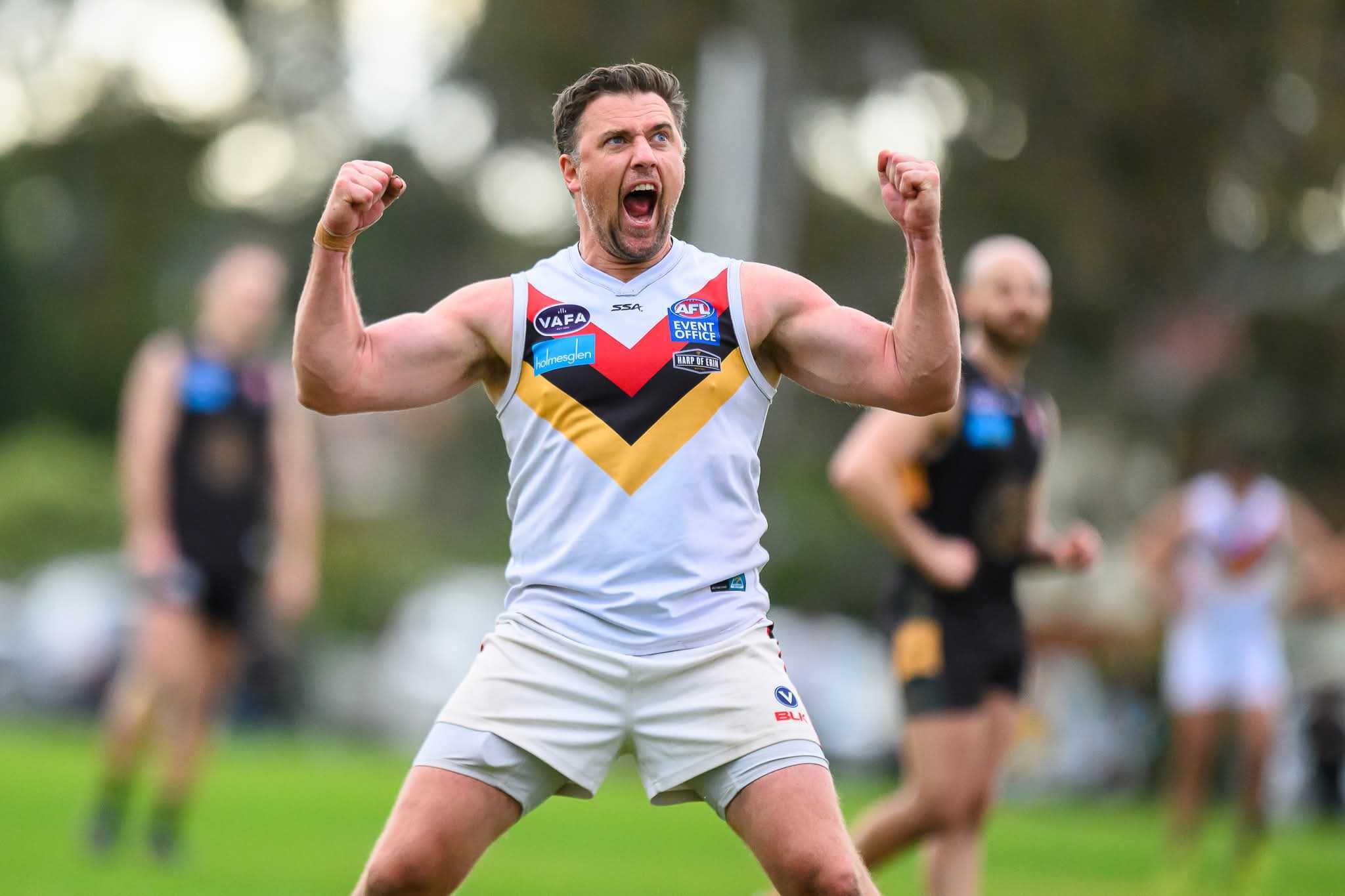
In many respects, the game reflected Canterbury's season. Things didn't click till time started to run out. Brad Kelleher kicked one six minutes later, and then snagged another – his third for the game – three minutes after that. Best-on-ground Tom Lowden ran down from the forward line to shore up the defence and started taking his trademark grabs. Players started to chip the ball around to wind the clock down. Now they knew it was theirs. They were enjoying the moment.
John Nicolopoulos made sure of it with two late goals to finish with four for the match, as Canterbury powered away.
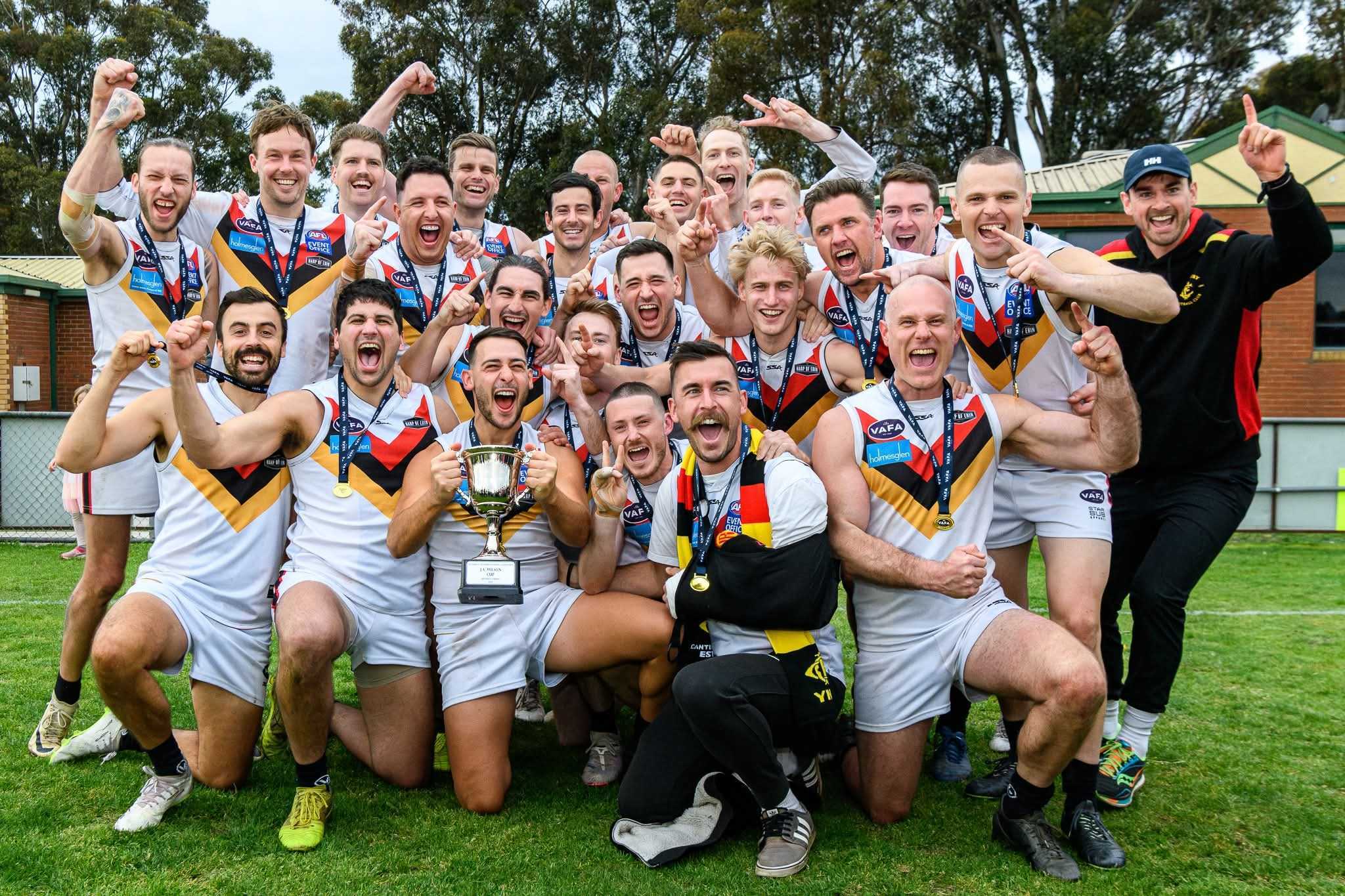
From facing a crisis which threatened the club's very existence just three years earlier, to encountering serious on-field challenges during the season, the club won the Division 3 Premiership – 11.22 (88) to 9.5 (59).
Michael Topp says while having a mature list was one of the reasons behind the sluggish start to the season, it paid dividends as the season went on, especially in the finals. "You take the emotion out of it a bit more as well when you've played a lot of footy. You're a bit more level-headed, which served us well because we were under pressure in every final at some point.
"When we found our mojo, our footy, and our form by the end of year, we were the fittest team and the ones who were least fatigued. That played a big part for us."
Premiership captain James Boarotto – who was named captain of the VAFA Division 3 Team of the Year – says it was redemption for four-goal hero John Nicolopoulos. Nicolopoulos ran into an open goal which would have won a 2022 semi-final against Parkside, only for the siren to go just before the ball hit his boot.
"He was pretty much our fifth or sixth best forward, but on Grand Final day, he was our best because they never had a match-up for him. So it was awesome to see him pop up and kick the four goals in the end."
It's often said a team will play in a way that reflects the character of the coach. Mitch Szabo says that was very much the case with Ward in charge. "Wardy was very good in that he coached in the way the majority of the group wanted to be coached."
Walmsley had done everything there was to be done at the club. He's even had the club's best and fairest award named in his honour. But he'd never won a premiership. Not until now, anyway.
For Aaron Daniel, it was validation and vindication. It validated all the work that he and his off-field team had done to drag the club out of the fire. You can't build a pyramid from the top. To have a high peak you need a broad base with strong foundations. He singles out Mitch and Shannon Deane, along with Phil Morris, for their efforts during the season.
His decision to stay in Division 3 was vindicated not by the premiership itself, but the way it was won. "It was staggering to think that they thought we'd go 18-0 and romp it in. We'd done it the hard way.
"It was never a job I took on expecting to win flags," he says. "For me it was just about leaving the place better than it was. I've done that."
| Q1 | Q2 | Q3 | Q4 | |
|---|---|---|---|---|
| St Johns | 5.0 - 30 | 6.0 - 36 | 9.4 - 58 | 9.5 - 59 |
| Canterbury | 4.6 - 30 | 5.13 - 43 | 6.16 - 52 | 11.22 - 88 |
Goal kickers: John Nicolopoulos 4, Brad Kelleher 3, Jayden Cutts 2, James Boarotto, Rohan Walmsley
Best players: Tom Lowden, Brad Kelleher, John Nicolopoulos, James Boarotto, Mitch Szabo, Nathan Beacom
The Final Word
There's a difference between history and tradition. History is something that has been and gone. Tradition is something that is passed down and continues. Canterbury was established in 1881 and is in the fortunate position to have both. It's part of the reason it has not just survived, but has punched above its weight, from the time Queen Victoria was on the throne, through both world wars, the Great Depression, a couple of pandemics, to today's digital age.
It's also a reason Canterbury won the 2024 premiership. It proved yet again, a hard fall means a high bounce if you're made of the right stuff. And Canterbury has always had people who are made of the right stuff.